27/05/2026
15th October 2026
In October 1871, one hundred and fifty five years ago this month, great alarm was caused in the Club when it was learned that the Commissioners of Irish Lights proposed to shift their operations at North Wall to new buildings to be erected to the west of the Clubhouse. The origins of the Commissioners lay in an Act of Grattan’s Parliament (1786) which established the Corporation for Preserving and Improving the Port of Dublin for lighthouses in the immediate area. In 1867, the landmark Dublin Port Act renamed the Corporation as the Dublin Port and Docks Board, giving it responsibility for Dublin Port only, while responsibility for lighthouses, lightships, buoys and beacons around the coast of Ireland was vested in the Commissioners of Irish Lights.
1871 was a busy year for the Commissioners. At the historic Hook Head lighthouse in Co. Wexford, new gas lights were installed, powered by gas manufactured directly on-site in a specially constructed gas yard. The new lights replaced the whale oil lantern installed in 1791 and marked a major modernization leap before the subsequent transition to paraffin oil and, eventually, electricity.
The experimental American Daboll air trumpet foghorn was being tested for the Baily Lighthouse at Howth Head. The Commissioners had seen the new machine at an exhibition in Paris four year earlier in 1867 and had arranged for it to be transported to Dublin. The foghorn mechanism used a small engine to compress air into a cylinder, forcing it through a vibrating steel reed and a large resonating horn to produce a loud, droning blast. This was a considerable upgrade on the lighthouse's previous acoustic safety measure which was a basic fog bell installed in the 1850s. Technology was developing rapidly however, and the trumpet would be replaced by a louder siren in 1879.
The landmark North Wall extension designed and directed by Bindon Blood Stoney, Chief Engineer of the Dublin Port and Docks Board, had commenced and would be completed in 1884. The 700-metre quay extension was built using massive 350-ton pre-cast concrete blocks laid underwater. Stoney invented a custom floating crane and a compressed-air Dublin Port Diving Bell (delivered in 1866 and operated from 1871 to 1958) to level the riverbed and position the blocks. The project marked a watershed moment in maritime engineering, proving that pre-cast concrete could reliably replace traditional stone masonry on a massive scale. It also paved the way for the development of the adjacent Alexandra Basin (completed in 1885).
Back at the Royal Irish, 1871 was a busy and successful year. Forty-eight new members were elected, and membership increased from 235 to 280. Queen Victoria presented a cup for the regatta, and a new billiard table was bought for £86, less an allowance of £25 for the old one. The Irish Lights proposal, however, caused consternation and an extraordinary general meeting was called. Members urged the Committee to continue their efforts to stop the development of the proposed new premises, on the grounds that it would be ‘as like destructive to the interests of the Club, the enjoyment of the public, as well as the pecuniary interest and comfort of the householders in the neighborhood’. Planning objections in Ireland go back a long way!
With the support of the Commodore, Lord Granard and the Town Commissioners of Kingstown, who organized a deputation to the Lord Lieutenant, the fifth Earl Spencer, the development was halted but, as it turned out, not abandoned. For many years the Commissioners had a depot on the site for servicing lightships and buoys, and finally in 2007 construction started on the striking circular award-winning building to the west of the Clubhouse which opened in 2008 as the Irish Lights shore headquarters. Today, the site hosts workshops, research and development departments and the extensive ‘buoy yard’ with a jetty to which their service vessel, the 80-meter 2,625-ton Granuaile can come alongside for direct access two hours either side of high water. After their historical differences, the Royal Irish Yacht Club and the Commissioners of Irish Lights are the friendliest of neighbours in Dún Laoghaire today.
Jane Mahony, 15 October 2026
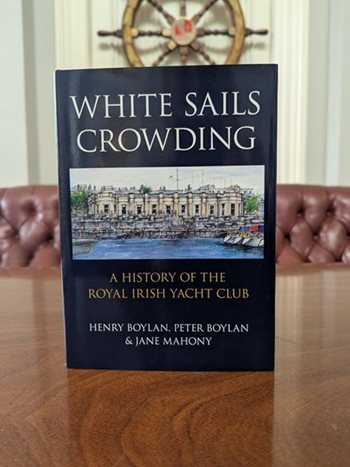
White Sails Crowding: A History of the Royal Irish Yacht Club is available from the Catering Department. An ideal Christmas present!
1st October 2026
This week we remember Henry Leonard, former Commodore and Royal Irish member for fifty-five years, with great affection and respect. When we were revising and updating the Club history, White Sails Crowding, Henry was generous with his time and support, and was hugely helpful in providing information, context and interesting facts. So much so that we included something Henry said to us during our research to conclude the Preface:
Henry Boylan observed in the first edition of this history that it could be said that the Royal Irish Yacht Club ‘existed on the periphery of history’ in its first eighty years, with the great political events of the day apparently having little impact on the lives of Club members. But of course, he noted, those years were passed in ‘an era of great stability, when one could plan five or ten years ahead in perfect confidence that no untoward external change would affect one’s life’. Modern life is altogether more unsettled in many ways. However, the Royal Irish remains a haven for its members. As former Commodore Henry Leonard observed, the term ‘safe harbour’ was adopted by the financial world for its own purposes. ‘For me there is no safer harbour than Dún Laoghaire and, within it, the Royal Irish Yacht Club. My wish for future generations is that they will have many, many happy years of safe sailing.’
Henry Leonard contributed much to the Royal Irish as a sailor, race officer, flag officer and long-time member. He ‘dealt with the logistics’, as he put it, of the first after-sail barbecue on the deck in 1991. Elected Rear-Commodore Sailing in 2006, he oversaw a particularly successful sailing season with notable RIYC participation not only in DBSC racing, but also in the various Club regattas, the hosting of the ICRAs in May, the Round Ireland race, the success of Tim Costello’s Tiamat in the IRCs and the Commodores’ Cup in Cowes.
A highlight of Henry’s first season as RCS was the Club’s Regatta with a record entry and every boat finishing inside the time. It was a particularly fine summer and there was, observed the July 2006 Sailing Newsletter, ‘a great atmosphere on the deck with music and all the other activities and a general spirit of joie de vivre.’
Henry Leonard was elected Commodore in 2010, proposed by John Kidney who commended his dedication to the Royal Irish since 1972, especially in his role as principal race officer. As Vice-Commodore from 2008, working with Commodore Tim Goodbody, much was achieved for the Club despite the difficulties following the financial crash. Henry noted the many successes of Tim Goodbody’s tenure as Commodore including the ‘signing of the 999-year lease, the refurbishment of the Drawing Room, Wet Bar and Cellar, the sailing bag racks, the more efficient gas boilers, the new committee boat, Spirit of the Irish, the new deck furniture and the rotisserie’.
As Commodore from 2010 to 2012, Henry oversaw the Royal Irish’s 180th anniversary celebrations in August 2011 which were deemed a memorable success. As well as his sterling work on the Club regattas, his successor as Commodore, Paddy McSwiney, noted that Henry’s ‘legacy will be reinventing the usage of the Club with all the different groups such as cycling and art and introduction of the Pearl Lunch and the Associate Members’ Lunch, the showcases in the corridor downstairs and the display tables in the bar. Trustee David Beattie noted ‘how lucky the Club was to have had Henry Leonard as Commodore.’ He was presented with an 1830s antique desk top writing bureau, of the kind used by earlier generations of seafaring men or ships’ captains.
In 2015, Henry and Caroline Leonard contributed to the restoration of our beautiful Georgian mahogany long case clock in the Hall made by the Dublin clockmaker Samuel Busby around 1760. A paper inside the clock records their generous sponsorship together with that of James Horan, Paddy McSwiney, Terry Johnson, Michael and Jeffery Jenkins, and Alan Keane.
The following year Henry presented a magnificent addition to the Terrace with the generous gift of five newly cast brass cannons with their cast iron lion carriages to replace the five historic and original cannons stolen many years previously. He found a specialist foundry in Athy to undertake the work. Henry described the gift as a gesture of his gratitude ‘for the many years of fun, camaraderie, friendship and sailing experiences’ that he had enjoyed in the Royal Irish.
This week we remember Henry and Caroline Leonard with gratitude and affection, and send our condolences to Mary, Simon, Sarah-Jane, Shirley, Kevin and Ralph, grandchildren and the wider family. May Henry Rest in Peace.
Jane Mahony and Peter Boylan
24th September 2026
The art collection of the Royal Irish Yacht Club contains some fine portraits of distinguished past members. The painting of Herbert Dudgeon (1869-1953) which hangs over the east fireplace in the Dining Room is a notable example. The painting is interesting for both its subject and its artist, Leo Whelan, RHA (1892-1956) and members may look at it with fresh eyes knowing more about both men.
Herbert Dudgeon was elected Commodore in March 1937, succeeding HRH the Prince of Wales who had been Commodore since 1920. In January 1936, the Prince had become King Edward VIII for less than a year before abdicating in December in order to marry divorcée Wallis Simpson. The Club’s AGM of 1936 did not proceed with the election of a Commodore pending advice from Buckingham Palace as to whether it would be in order to invite the new King to continue as Commodore. The Palace replied that the King would communicate to the Club in due course, but there is no record of any decision being so communicated. The King had other things on his mind.
Herbert Dudgeon was the first Commodore of the Royal Irish not drawn from the aristocracy. As well as the Prince of Wales, his predecessors were the Marquesses of Anglesey, Donegall and Ormonde and the Earl of Granard. Dudgeon was a stockbroker in the family firm in Dublin, Dudgeon & Sons (there were five sons and six daughters in the family), following his father who had been stockbroker and agent to the Suez Canal in 1858. Dudgeon joined the Royal Irish in 1888, was elected Rear-Commodore in 1924 and Vice-Commodore in 1925.
Herbert Dudgeon remained Commodore until his death in July 1953, aged eighty-three, having been a member of the Club for sixty-five years. He was an active yachtsman and owned a 15-ton yawl called Mabel, which unfortunately sank at her moorings in the harbour one day. His widow generously presented the Club with his punt and motor-boat.
In June 1938, at a special dinner to mark his fiftieth year of membership, members presented Dudgeon with his portrait in oils painted by Leo Whelan. It was exhibited at the Royal Institute Galleries in London the following year. Whelan was born in Dublin and educated at Belvedere College and the Dublin Metropolitan School of Art, where he was a pupil of William Orpen. Whelan exhibited nearly 250 works at the RHA from 1911 until 1956, including many portraits of leading figures in the spheres of politics, academia, religion, society, medicine, and the law. He designed the first Free State commemorative stamp, a portrait of Royal Irish founding member Daniel O'Connell, issued in 1929 for the centenary of Catholic Emancipation.
Leo Whelan was from a family of militant nationalist sympathies. In 1922 he began a large group portrait, ‘GHQ staff of the pre-treaty IRA’, including Michael Collins, Richard Mulcahy, Rory O'Connor, Liam Mellows, and nine others, composed from individual studies of the men rendered during clandestine sittings in his home and studio; the painting, which Whelan left unfinished, is today in McKee Barracks near the Phoenix Park.
Whelan’s political portraits, observes Carmel Doyle in the Dictionary of Irish Biography were influential in ‘creating a strong, assured image of the newly formed Irish state’, and thus retain an historical significance. His posthumous portrait, ‘The late General Michael Collins’, exhibited at the RHA in 1943 and now held in Leinster House, exhibits the same technique at the Herbert Dudgeon portrait: ‘a sombre, restricted palette, with the sitter placed, in grave demeanour, against a monotone background with few accessories’.
Whelan’s posthumous portraits of Arthur Griffith and Kevin O'Higgins also hang in Leinster House, while that of John A. Costello, exhibited at the RHA in 1949, is now held in the King's Inns, Dublin. Whelan painted two presidents, Douglas Hyde and Seán T. O'Kelly and both works are in Áras an Uachtaráin. A portrait of Éamon de Valera, painted in 1955 when the sitter was leader of the opposition, is in Leinster House. In 1954 Whelan designed a second commemorative stamp, picturing a reproduction of a portrait bust of John Henry Newman, to mark the centenary of the Catholic University of Ireland.
Our portrait of Herbert Dudgeon is a fine example of Leo Whelan’s work.
WEEK SEVEN - 16TH July 2026
One hundred and one years ago this week, on 15 July 1925, a special dinner was held in the Dining Room for 50 Club members. The occasion was a celebration of the return of Royal Irish member Conor O’Brien from a historic two-year circumnavigation of the world. O’Brien sailed his 42ft ketch Saoirse into Dún Laoghaire on 20 June 1925, at precisely 4.30 pm, exactly two years to the second since his departure on 20 June 1923 at 4.30pm.
O’Brien was the first Irishman to sail around the world in his own yacht and fly the tricolour of the new Irish Free State when entering port. He also flew the ensign of the Royal Irish telling those he met, including a newspaper in Auckland, New Zealand, that the ensign was that of the club ‘that gave the best dinners in Dublin’. (Still does actually - O’Brien would no doubt be delighted that the Club this month achieved the fantastic first place at the Gold Medal Catering Awards for best in-house club catering!).
Over the years, there have been many remarkable Club members, but Conor O’Brien was one of the most remarkable. Born in Co. Limerick in November 1880, he was a grandson of William Smith O’Brien, the Young Irelander. He was educated at Winchester College in England, Trinity College, Dublin and Oxford and became an architect by profession. He was a founding member with Arthur Griffith of the old Sinn Féin party in 1905 and an Irish speaker. He delighted in sports that had an element of danger and became an expert yachtsman and mountaineer.
After serving in the Royal Navy during the First World War, he returned to Ireland and had the 20-ton ketch Saoirse built to his own design by Tom Moynihan of the fishery school at Baltimore, Co. Cork. She was 42 feet long overall and 37 feet on the waterline, with a beam of 12 feet. The design was based on an Arklow fishing boat built in the 1860s on which O’Brien had sailed and whose qualities as a sea-going vessel had impressed him. O’Brien had intended to go as far as New Zealand to join a mountaineering party in the New Zealand Alps for Christmas 1923, but arriving too late decided to sail on, thus becoming the first yachtsman to circumnavigate the world by way of the three great capes, Cape of Good Hope, Cape Leeuwin and Cape Horn.
O’Brien’s cruise was a great achievement and won for him the Challenge Cup of the Royal Cruising Cup for 1923, 1924, and 1925. His account of the trip, Across Three Oceans, was published in 1926. The introduction to the book was written by Claud Worth, the renowned cruising yachtsman and Vice-Commodore of the Royal Cruising Club, who observed that:
‘Anyone who knows anything of the sea, following the course of the vessel day by day on the chart, will realise the good seamanship, vigilance and endurance required to drive this little bluff-bowed vessel with her foul uncoppered bottom, at speeds of from 150 to 17- miles a day, as well as the weight of wind and sea which must sometimes have been encountered.’
A huge crowd of around 30,000 gathered on 20 June 1925 at Dún Laoghaire to welcome O’Brien home. The Army Band was there, led by Lieutenant Arthur Duff. In a remarkable tribute, the Dublin Bay yachtsmen abandoned their cherished Saturday afternoon races to escort O’Brien into the harbour. The wind was light against a strong ebb tide, so he accepted a tow to his moorings from a motor launch steered by Tom Casement (a brother of Sir Roger) of the Coast Life Saving Services. O’Brien recorded in Across Three Oceans that: ‘I picked up the same mooring which I had let go exactly two years, to the second, previously.’
More on Conor O’Brien’s extraordinary life and adventures can be found in the Club History, White Sails Crowding, by Henry Boylan, Peter Boylan and Jane Mahony.
WEEK SIX - 2ND July 2026
During the 1840s, according to James Lyle the great sailing journalist of the day, the Royal Irish Yacht Club was sadly ‘in a failing state and heavily in debt for some time, its yachts fallen off and members resigned’.
On 4 July 1846, a meeting was held in Radley’s Hotel on College Green where 28 men gathered with the aim of reviving the Club. The most prominent members were the O’Connells – the great Liberator himself, Daniel O’Connell, then seventy years of age – and his sons Daniel and John. Others included four MPs, five barristers, four solicitors, three distillers, a merchant and a stockbroker.
This meeting was not only significant in our Club history, but was also a key moment in the huge shift that was taking place in Irish society more generally in the 1840s. The men at the meeting represented the rising Catholic and Dissenter middle-class professionals who, in the years after Catholic Emancipation and the final repeal of the Penal Laws in 1829, were in the vanguard of building new civic and political institutions across the country, thus beginning the process of dismantling the absolute power of the Protestant Ascendancy of the established Anglican Church.
A year earlier, Kingstown Boat Club, founded in 1838, has been granted royal status and renamed the Royal Kingstown Yacht Club. James Lyle recorded that ‘some unpleasantness rose owing to the rejection of candidates for membership’ in 1845. In the largely socially and culturally sectarian Dublin of the day, many of those rejected were Quakers and Dissenters. Lawyers or doctors were not welcome either, as the members did not want to be reminded of their legal or medical problems! There was clearly an opportunity for a rival yacht club.
The minutes of that first meeting – intentionally held on America’s Independence Day of 4 July - show that the members had a clear programme of action which they achieved in just a couple of months. The name of the Royal Irish Yacht Club was resumed, a successful application was made to the Admiralty in London for the granting of full privileges of a royal yacht club and a warrant for a distinguishing ensign and burgee, and Prince Albert and Queen Victoria agreed to become joint Patrons. Also on the agenda was the securing of a site in the harbour to build a club house. While new rules were made for the future club house, no fundamental changes were made to the 1833 Rule Book. The revived Royal Irish Yacht Club was up and running.
Readers will of course know that the Great Famine was ravaging the countryside at the time while normal life largely continued in Dublin. A sombre reminder of the conditions of the poor in the Ireland of 1846, including the many refugees who fled to the capital, came when John O’Connell MP informed the committee that he had been asked by the Kingstown Relief Fund to lay before the Club ‘the extreme state of destitution of the Poor Inhabitants in and around Kingstown’. A special meeting was held in December to enable members to subscribe to the fund.
We teased last week about the long-standing rivalry between the Royal Irish and the Royal St. George. This dates from 1848 when the sailing committee of the Royal Irish began to plan its first regatta. Having raised over £320 in subscriptions for the event, £100 of which came from the directors of the Dublin-Kingstown Railway, the Lord Lieutenant, the Earl of Clarendon was approached for his help in securing a royal cup to be awarded to the regatta winner. His Excellency was confused. He understood that there was another Royal Yacht Club in Kingstown which was senior to the Royal Irish. On being assured that this was not so, since the other club had only been the Royal St. George since the previous year when, for reasons lost in the mists of time, the Royal Kingstown YC became ‘the George’ in May 1847 and the Royal Irish dated from 1831, Lord Clarendon had a memorandum prepared on the subject to assist him in laying the matter before the Queen. Both clubs wanted a royal trophy and both claimed seniority. Both wanted to organise a regatta in the summer of 1848.
Her Majesty, or perhaps her advisors, devised a diplomatic solution to the difficulty. She would give a Queen’s Cup to each club in alternate years, and ‘that in order to place both Clubs on a perfect equality’ lots would be drawn to determine which Club would have it in the first year. On 30 June, at the Royal St. George’s club house, a half-crown was thrown in the air by their Honorary Secretary, Mr Vernon and called by the Royal Irish Vice-Commodore P. P. O’Kelly. The Royal Irish lost the toss, and so the Cup fell to the George in 1848 and the Royal Irish had to wait until 1849 to have the Queen’s Cup included in the prizes of our regatta. After this the two clubs came to an amicable arrangement to hold their regattas on alternate years. Amicable ‘rivalry’ has been an enjoyable feature of relationships between the Clubs ever since.
A new 'Porthole to the Past' will be published on 16 July.
WEEK FIVE - 25th June 2026
This week we will look at the highlights of the earliest regattas of the Royal Irish Yacht Club during the 1830s. In these early years, yachtsmen were mainly drawn from the ranks of the aristocracy and military, and royal patronage was important and valued. The first Club regatta took place over June 25-29, 1832, with the Commodore, the Marquess of Anglesey, presenting his Anglesey Cup, value 100 guineas, to the Earl of Belfast and his 162-ton cutter Louisa.
Notably our first regatta winner, Lord Belfast, was the great disrupter of yachting at the time and a pioneer of ocean racing. Having considered that he had exhausted the racing capabilities of standard fore-and-aft-rigged cutters like Louisa, he experimented with, and went on to commission, a series of two-masted brigantine rigged racing yachts with specially-constructed high tension sails. Coming to dominate yacht racing for a decade, Belfast demonstrated that brigs – the workhorses of the military and commercial fleets - could point close to the wind and outpace the finest vessels of both the yachting elite and the Royal Navy. He also transformed the sport into a high-stakes, endurance discipline. Before the 1830s, yachting had been primarily a leisure activity consisting of short, sheltered coastal cruises and minor regattas. Lord Belfast’s famous 1834 match race against the schooner Galatea - spanning a gruelling 224-mile course for a huge wager of £1,000 - is recognised as the world's first true ocean racing contest, paving the way for modern offshore racing.
The Duchess of Kent, mother of the future Queen Victoria, presented the Kent Cup for vessels under 50 tons belonging to members of the Club. It was won by the 42-ton Adelaide, owned by William Lander. The Gresham Challenge Cup, value 20 guineas, for four-oared gigs was wone by the celebrated Kennedy crew of brothers, with Matthew Kendrick as stroke. Kendrick of course was later marine painter to the RIYC, Keeper of the Royal Hibernian Academy and one of the finest yachtsmen of the day. One of his finest seascapes, ‘Mail Steamer Leinster off Kingstown 1866’ hangs in the Drawing Room.
The great prize at the 1835 regatta was a gold challenge cup, value 100 guineas, presented by the directors of the Dublin and Kingstown Railway, which had been opened in December 1834 as the first passenger railway in Ireland. The cup was won by the 75-ton Fanny, owned by James Meiklam, the pioneering Scottish yachtsman of the Royal Northern Yacht Club. Fanny came to Dublin having dominated the previous season with wins in five Scottish and Irish regattas.
In presenting a prize for the 1836 Regatta, the Duchess of Kent, specially directed that it should be made in Dublin instead of London and be known by her Irish title, the Countess of Dublin Cup. She presented not a cup but a pair of identical silver claret jugs, which were lost to the Club for many years, but returned forty years ago in 1986, thanks to the generosity of Peter Odlum. The first winner was the 47-ton Medora, owned by Lt. Col. Augustus Cuyler, chief commissioner of the Dublin Metropolitan Police. Col. Cuyler died just a year later at the age of 40.
The great controversy of the 1836 Regatta was the objection lodged to Zephyr, the winner of the race for yachts under 20 tons, as being over tonnage. An appeal was made to the surveyor, who measured her at 19.93/94 tons – a close-run thing. No doubt it was pure coincidence that the surveyor was a Cork man and the Zephyr was owned by a member of the Royal Cork Yacht Club!
King William IV died on the second day of the 1837 Regatta, which caused the remaining races to be postponed for a month. The 1838 Regatta was fixed for 28 June, in honour of Queen Victoria’s coronation on the same day and was a very grand affair. The Queen then became Patroness of the RIYC in succession to her mother.
Regattas were held in 1839 and 1840 on a smaller scale, but it would be 1848 before the next Royal Irish regatta was held on 4-6 July. As we shall see next week, it can fairly be said that the great rivalry between the Royal Irish and the Royal St George dates from this time when Queen Victoria herself had to make a judgement of Solomon as to which club was the ‘senior’ of the two!
A new 'Porthole to the Past' will be published on 14 July.
WEEK FOUR - 18th June 2026
Continuing with extracts from the Club History, White Sails Crowding, we take a look at our beautiful club-house as the week of 195th anniversary celebrations gets underway. The Royal Irish is privileged to have the oldest purpose-built yacht club-house in the world, a classical and elegant building of distinction, dating from 1851, designed by the eminent architect John Skipton Mulvany (1813-1870).
Although the Admiralty in London granted a site and permission to the Royal Irish to build a club-house in October 1846, a year of obstruction by the Commissioners of the Board of Public Works meant it was December 1847 before the Vice-Commodore, Pentheny P. O’Kelly, could raise the Club burgee over the site and works begin.
On 8 April 1851, the club-house with its fine entrance portico enclosed in a colonnade of eight Ionic columns was declared open. Today, the beautiful and welcoming entrance hall is virtually unchanged, perfectly symmetrical and lit by a domed skylight ten feet in diameter which incorporates a symbolical compass rose. The interior layout upstairs has remained largely unchanged, a tribute to Mulvany’s skill. The corridors leading from the hall are lit by four smaller round skylights and their barrel-vaulted ceilings echo the curved dome in the hall and Mulvany cleverly exploited natural light throughout the interior of the whole building. The principal rooms enjoy a fine view of the marina and harbour, with the Club situated directly facing the wide entrance between the East and West Piers. The Billiard Room is an important part of the Club heritage being one of the few surviving purpose-built nineteenth-century billiard-rooms in Ireland.
Tomorrow, the magnificent Drawing Room, most recently redecorated in 2023, will host the Classic Regatta Reception. Members might enjoy looking afresh at the three beautiful and historical window pelmets and the superb chandeliers. The restoration of the pelmets was the great surprise and joy of the conservation work in 2023. They had been painted over with a thick brown paint an unknown number of years before. This paint was removed by the expert conservators, revealing the original exquisite pelmets which were then overlaid with individual sheets of delicate gold leaf, restoring them to their former glory, and allowing the intricate detail of the Club’s crest surmounted by a magnificent crown to be seen for the first time in many years. The brilliant chandeliers were installed in 1986 thanks to a most generous bequest by Peter Odlum.
Since Mulvany’s day, the Dining Room has seen two rooms opened to each other to make the notably elegant and comfortable room we know today. At the Regatta Gala Supper on Saturday we will see the antique tables set with shining silver cutlery and glasses, and decorated with candles and flowers. There are few more beautiful rooms in Dublin.
The greatest change to the Royal Irish club-house since 1851 can be seen in the downstairs floor where the Changing Rooms and Wet Bar are located, and in the extensions to the East and West Decks. Much of this work stems from the ambitious and successful RIYC 2000 project which saw the Club making the major investment that continues to benefit the Club today.
The relocation of the Boathouse to the West End of the Deck opened up the opportunity for redevelopment and expansion. Then Commodore Denis Woods drove the vision of upgrading the Wet Bar, working with future Commodores, the architect James Horan and Paddy McSwiney. As the club-house is a protected structure, a sympathetic approach was essential. The award-winning architectural design reimagined a space which resembled the inside of the hull of a boat. The existing windows became portholes, and lighting and cabling were concealed behind the oak hull. The beautiful brick vault ceilings and stone walls were cleaned. The old semi-circular bar counter from the members’ bar was installed in the wet bar and painted. The Library was renovated, and the granite columns are all that remain of the original Boathouse.
The RIYC 2000 project transformed the use of the Wet Bar and expanded the range of activities. Curved sliding doors added later allowed the space to be partitioned as needed. Dance classes, for example, can take part in one section, while the Cadets gather for instruction in another. Large and small functions can now be accommodated, and the Club now offers both the formality of the Dining Room and the informality of the Wet Bar to members and their guests.
Next week as the Club Regatta gets underway we will move from the shore onto the water to look at regattas and races over the years and the great achievements of Royal Irish sailors.
WEEK THREE - 11th June 2026
With fingers crossed for good weather for the Classics Regatta on 20 and 21 June and the Club Regatta on 27 June, members might like to take a fresh look at the painting of the Club’s 1873 Regatta which hangs in the Drawing Room. The finest painting in the Club’s collection – Yachts Racing for the Royal Irish Yacht Club (1873) in a Strong Sea by Richard Brydges Beechey – depicts the eight competing boats just off the Muglins, looking northwards to Howth in the distance. It was the first leg of a race of mixed handicapped fleet of cutters and schooners. The race most likely started from an anchored line inside the harbour, with mainsails hoisted, given that flying starts were still experimental at this date. A stiff southerly wind is blowing so all the cutters have reduced sail and their retractable top masts have been ‘sent down’, while the schooners are carrying small triangular mainsails.
As well as the original painting, the Club has two lithographs of the work, one coloured and hanging in the Members’ Bar, and a sepia version in the Bar, which provide the key to what is happening in the race. The largest cutter Garrion (98 tons) is in the lead, closely followed by the largest schooners Gwendolyn (84 tons) and Pantomime (140 tons). Arethusa in the foreground is fourth, while Fiona in fifth place is tacking for the mark. The last three boats are Iona, Flying Cloud and Oimara.
Hal Sisk and Iain McAllister have a lively account of an eventful race in variable conditions:
“Pantomime’s bobstay took a chunk out of Oimara's counter at the start. Garrion's mainsail separated from its luff rope, and Gwendolyn later broke off her bowsprit at the stem after a second collision with Oimara’s counter. Such accidents were commonplace and were mentioned casually in the race report without comment or attribution of blame.
After the fleet rounded the Rosbeg, the wind dropped near the South Bull and it became a drifting match for a while, before the wind rose again allowing a second round to be completed. Astonishingly in a modern context, there were no protests, and despite her early collision, Pantomime was declared the winner.”
Pantomime had the best racing record of the schooners in Britain and Ireland in the 1873 season with eight first prizes and five second. Almost all the yachts in the race are visiting from England and Scotland, with the exception of Flying Cloud, owned by the splendidly named Baget Blood, Esq., of Dublin. All were sailed by professional crews for their owners, who were relatively few in number, given the high cost of maintaining a large professional crew and the difficulty of getting from one regatta to another.
During the 1873 season, the twenty-two Royal Yacht Clubs of Britain and Ireland organised 155 races, of which seventy-nine or just over half were in Ireland and Scotland. As Hal Sisk observes, ‘the yacht clubs in the Irish Sea and North Channel represented a major counterweight to the English yachting scene. While there were more yachts and clubs in the South of England, the sport of yachting was to a great extent shaped and popularised in the Irish Sea.
Richard Brydges Beechey (1808-1895) was an artist, naval officer, and marine surveyor who lived for many years at 2 Belgrave Square in Monkstown. He took part in the 1824
Blockade of Algiers, and on HMS Blossom spent three years in the Pacific between 1825 and 1828 surveying the Pacific Islands and the coasts of California and China. Beechey painted a number of lighthouses and light ships around the Irish coast, characteristically under rough conditions, and he portrayed yacht races, such as that of the Royal Irish Regatta, in great detail recording accurately the rigging and other details of the competing craft against translucent wave effects.
WEEK TWO - 4th June 2026
With the growth of the sport of yachting in British and Irish waters in the 1820s, as we saw last week, yacht clubs began to be established. The Royal Thames Yacht Club had been founded in 1775 and the Royal Yacht Squadron in 1815. The Royal Northern & Clyde Yacht Club was founded in 1824, soon followed by other Royal Clubs in Singapore, Plymouth, Gibraltar and Stockholm.
In Dublin meanwhile, shipping and yachting had been transformed by the development of the great ‘Asylum’ harbour from 1817 at the old fishing village of Dunleary, renamed Kingstown in 1821 to mark the visit of King William IV. Before the harbour was built, yachts lay in the Liffey and the Dodder rivers, and at the end of a day's sailing in the bay, their crews often had to beat upriver against the tide, a laborious and tiring endeavour.
The port of Dublin had been difficult to access except at high tide due to a sandbar across the mouth of the Liffey. Sudden storms were common, and with no shelter in Dublin Bay, there were hundreds of shipwrecks over the centuries. As Captain Charles Malcolm of George IV’s Royal Yacht observed:
The Bay of Dublin has perhaps been more fatal to seamen and ships than any in the world, for a ship once caught in it in a gale of wind from ENE to SSE must ride it out at anchor or go on shore, and from the nature of that shore the whole of the crews almost invariably have perished.
The dangers of the coast and the need for a secure harbour came tragically to widespread public attention in November 1807 when two troopships, the Prince of Wales and the Rochdale, were wrecked in gale force winds and heavy snow off Blackrock and Seapoint. Dubliners were shocked to see 400 bodies washed ashore on the city's coastline and officialdom was finally spurred into action.
The Dublin-based shipbroker Richard Toutcher began a one-man campaign to have a pier built near Dunleary to provide shelter to shipping in storms. His campaign led to the passing of an Act of Parliament in 1815 when eight harbour commissioners were appointed to supervise the building of a new harbour designed by the Scottish architect, John Rennie. Work began on the East Pier in 1817 and by 1821 both East and West Piers had been constructed from granite mined in Dalkey, although the pierheads with their lighthouses were not completed until 1840.
On 15 September 1831, a group of keen yachtsmen met at the Gresham Hotel to discuss the founding of a yacht club and prepare rules. Five days later, a second meeting adopted the name of ‘The Royal Irish Yacht Club’. The Marquess of Anglesey agreed to be the first Commodore, and Colonel Owen Lloyd was the first Secretary. Saunder’s News-Letter of 26 September announced that the ‘greater number of leading Irish yachtsmen had joined the Club’. The Iron Duke himself, the Duke of Wellington, was an early member, as were the
Earl of Belfast, owner of the famous 162-ton racing cutter, Louisa, his father, the Marquess of Donegall, and their kinsman Lord Chichester, the great advocate for the abolition of slavery and Chief Secretary of Ireland. An entrance fee of five guineas was charged, with an annual subscription of three guineas. By 1833 the Royal Irish had 254 members including the whiskey magnates James and John Jameson, George III’s son, the Duke of Sussex, and Colonel John Madden of Hilton Park, Co. Monaghan, the prominent landowner and enthusiastic yachtsman who owned the 69-ton cutter Ganymede.
On 17 October 1831, the Admiralty in London granted the Royal Irish permission to fly the White Ensign. The Club therefore became the third yacht club to obtain an Admiralty warrant, and the only the second (after the Royal Yacht Squadron in 1829) to be permitted the White Ensign.
As we shall see next week, the Committee now began to plan the Royal Irish’s first regatta with the dates 25-29 June 1832 fixed, and a general subscription list to provide funds opened among ‘the citizens of Dublin, the officers of the garrison and the ladies.’
Peter Boylan and Jane Mahony.
WEEK ONE - 28th May 2026
As we look forward to the Royal Irish Yacht Club’s 195th anniversary week, with the Classic Regatta on 20 and 21 June and the Club regatta on 27 June, our Club History White Sails Crowding tells the story of the first ever regatta in Dublin Bay in 1828 which led on to the founding of the RIYC three years later.
Recreational sailing had all but disappeared from Irish and British waters in the years of blockade and danger during the Napoleonic Wars. It was only after the decisive defeat of Napoleon at the Battle of Waterloo in 1815 that the sport of sailing was able to grow and organise formally. The Ports of Dartmouth and Plymouth held regattas in 1822 and 1823 and the Royal Yacht Squadron launched the first Cowes Week in 1826.
In Dublin, the appointment in 1828 of Lord Anglesey, Waterloo hero and keen sailor, as Lord Lieutenant of Ireland, was the spur to renewed sailing activity in the bay. Despite losing his leg at Waterloo, Anglesey was a renowned sailor and proud owner of the fastest super-yacht of the day, the 68 foot, 113-ton cutter Pearl. Anglesey had looked for the builder of the fastest boats in Britain, and found him in Philip Sainty of Essex. The problem was that Sainty was in jail. He had been caught out both building fast Revenue cutters and fruit schooners to catch smugglers, while simultaneously building even faster, more manoeuvrable vessels for the smugglers themselves to outrun the official craft. Pearl was Sainty’s ‘Get out of Jail’ card.
On 22 July 1828, Anglesey inaugurated the first regatta in the newly-constructed Kingstown Harbour, anchoring Pearl as a spectator vessel at the finish line. Huge crowds turned out to watch the racing in excellent conditions of sun and wind, before a heavy afternoon downpour drove them to the shelter of the tents and booths set up along the foreshore. The Earl of Elgin’s Liberty won the Fifty Guinea Cup and such was the success of the event that another regatta was held in 1829, with even larger crowds of enthusiastic spectators.
There was no regatta in 1830 due to the death of George IV, but yachting was now firmly established in Dublin Bay. The next step was surely the establishment of a yacht club.
Jane Mahony

White Sails Crowding: A History of the Royal Irish Yacht Club is available to purchase in the Club.
Contact the Catering Office to purchase.